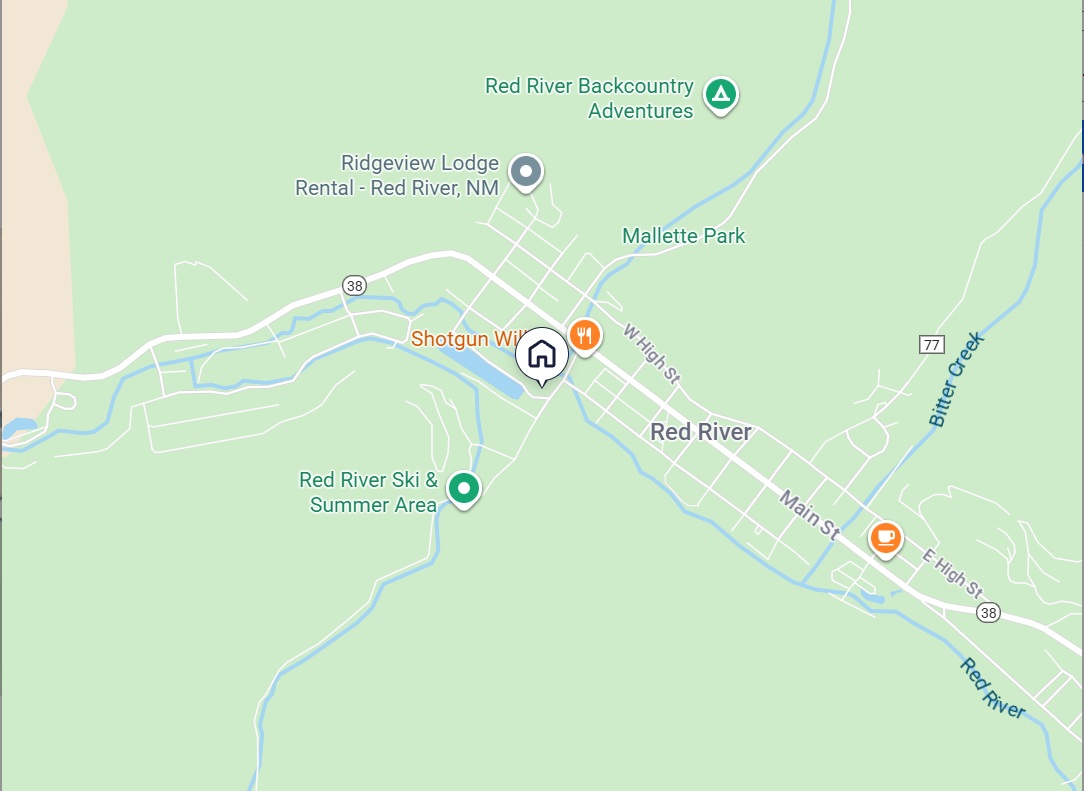
Walk Main Street in Red River and the town's first building material is everywhere: timber. Log cabins, wood-frame storefronts and slab-sided lodges line a street that grew up in a hurry in the 1890s, when canyon sawmills could turn the surrounding forest into a saloon, a hotel or a miner's cabin in short order. In the middle of all that wood, one house breaks the pattern. The Brigham J. Young House, on Main Street, was built of brick — and as far as local history can tell, it is the only structure in Red River that ever was.
That fact says a lot about the boomtown it was built in. Red River's population climbed to about 3,000 by 1900, with fifteen saloons, four hotels, a sawmill, a barbershop and a red-light district, according to the town's historic profile. It was a place built for speed. Timber was close at hand, and a mining town that might fade in a few seasons had little reason to invest in masonry. Brick had to be made, not just felled, and in Red River that meant one man's side business had to come first.
The bricks came from Orin Mallette. The French-Canadian trapper turned blacksmith, farmer and miner established a brick kiln about 1894 on his property at the western end of the valley, to supply the growing boom town, according to the history kept by 4K River Ranch, which now occupies that land. The bricks were soft, and a distinctive pastel pinkish-orange in color. Most never became walls at all: as far as is known, the Young House is the only building in town constructed of them, though Mallette brick was also used for chimneys around Red River.
Every other early landmark in town tells its story in logs — the Mallette brothers' own cabins, the Pierce-Fuller House on High Street, the Melson-Oldham Cabin. The Young House tells a different one: of a brief moment when a builder, and a local kiln, tried something more permanent. Whether it was ambition, fire-sense or simple preference, the record preserved today does not say, and the honest answer is that the reason is lost. What survives is the result.
The house's importance was recognized on February 23, 1984, when it was entered on the National Register of Historic Places. It was not listed alone. That day, five other Red River properties joined the Register: the Orin Mallette Cabin, the Sylvester M. Mallette Cabin, the Melson-Oldham Cabin, the Pierce-Fuller House and the Red River Schoolhouse. Together they form a small archive of the town's early years — the Young House the brick entry in a set built of wood.
Mallette's kiln no longer stands, so the most durable evidence of his brickmaking is not where the bricks were fired. It is here, on Main Street, in the walls of the one house they became. Chimneys built of the same soft, pinkish-orange brick carry the story further, scattered through town.
So the next time you stroll Main Street — past the saloons and steak houses and shops that still follow the old boomtown line — keep an eye out for brick among the timber. You will only find it once. That is what makes the Young House worth noticing: in a town built quickly out of the forest around it, one builder slowed down, used a kiln's worth of local brick, and left Red River a landmark unlike any other on its main street.
Planning a Red River getaway? Book your stay at the Claim Jumper A-Frame 6